
Transformation stories: from process constraint to working change
Technology matters when it changes how work gets done. Explore engineering process transformation case studies that connect a recurring engineering or information problem with a practical intervention and a different way of working.
What makes a transformation story?
A transformation story explains the working process before and after an intervention. It identifies the constraint, shows what was changed and separates delivered capabilities from future opportunities. The emphasis is on the relationship between people, process, information and technology - not simply a list of tools.
A transformation story explains the working process before and after an intervention.
It identifies the constraint, shows what was changed and separates delivered capabilities from future opportunities.
The emphasis is on the relationship between people, process, information and technology - not simply a list of tools.
Three processes, three different constraints
From Disconnected Tools to Model-Driven Documentation
A specialist window-system manufacturer relied on several tools to prepare engineering documentation. nCircle Tech developed a Revit-based workflow for parametric configuration and documentation outputs - making product information reusable across an engineering pack. Model-driven sheets, schedules and exports replaced repeated preparation steps. Proposed expansion to other products or ERP integration is a later opportunity, not evidence of work already delivered.
Explore model-driven window documentationFrom a Legacy Desktop Application to a Web-Based Facility Platform
faciliCAD needed to evolve a facility-software product while retaining its connection to drawings and operational information. nCircle Tech's work combined application modernization with AutoCAD-linked data, inspection workflows and reporting - an engineering software modernization case study that helps software leaders examine continuity as well as change.
Explore faciliCAD's platform modernisationFrom Separate Construction and Financial Records to Connected Visibility
HDCC used ACC and CMiC for different parts of its operations. The integration project connected selected records and introduced checks and status visibility across the workflow - a construction systems integration story about how a record moves, how it's matched and what happens when an update fails.
Explore HDCC's connected workflowAll transformation stories
Each story starts with the working process and shows what changed around it.
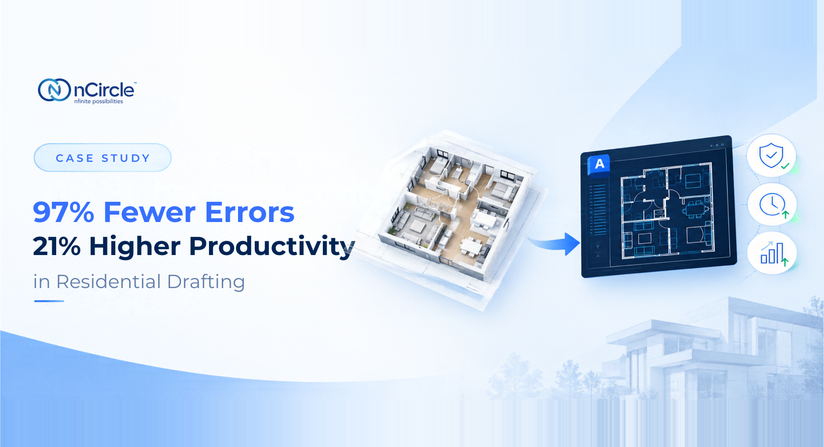
Reducing Rework at Scale: How nCircle Drove 97% Error Reduction and 21% Higher Productivity in Residential Drafting
Quick summary: nCircle Tech helped a residential builder standardize its PDF-to-AutoCAD drafting workflow by converting builder plan PDFs into AutoCAD 2024 DWG floor plans using defined CAD standards, client-provided libraries, and structured quality checks....
- Industry: Residential Construction / AEC
- Service: PDF-to-AutoCAD Drafting Support
- Input: Residential builder plan PDFs

Empowering Electrical Projects with Revit BIM: How nCircle Tech Helped an Electrical Contractor Modernize Site Coordination
Helping Electrical Contractors Work Smarter with MEPF BIM Services Client Overview The client is a long-established electrical contracting firm based in British Columbia, Canada. With a history going back to the early 1900s, the company delivers electrical...
- Heavy reliance on 2D drawings limiting constructability
- Siloed coordination causing on-site clashes and rework
- Difficulty tracking elements across phased construction

Transforming Legacy CAFM to Web-Based CAFM with APS for faciliCAD
faciliCAD, a trusted name in space and asset management, needed to modernize its legacy system to keep pace with evolving market demands. Originally built on Microsoft Access and deployed as a desktop solution, the platform was becoming increasingly difficult...
- Space and vacancy management
- Emergency-use asset inspections
- Rent and revenue reporting

How nCircle Automation Revolutionized Design Efficiency for a Sewage Treatment Plant Company
The AEC and manufacturing industries can no longer afford to slow down– be it in terms of initial planning and designing stages or delivery. In a world defined by fast-paced developments, there’s simply no room for inefficiency or errors. Yet, for many teams,...
- Human Error: Prone to mistakes during drafting and modeling.
- Rework: Frequent errors mean additional cycles of review and revision.
- Low Scalability: Unable to handle large volumes of designs efficiently.

Elevating Efficiency: The Impact of a Custom 3D Web Platform on a Leading U.S. General Contractor
New-age AEC initiatives are thriving by leveraging the dynamism of effective project documentation and 3D model management facilities. But how? AEC projects often need a centralised repository associated with structured 3D models. Such models help bring the...
- Absence of a centrally structured platform, specifically for 3D models
- Utilisation of box being the chosen method for all sorts of file storage
- Lack of a dedicated 3D or 2D platform for stakeholders to map data in real-time

A leading co-working space provider increased its BIM designing efficiency by 25% while working with us
About Client: The client is a leading company in co-working space providing solutions for commercial office space to minimize the headaches of upfront investment and long leases. They provide a flexible real estate platform that allows using personal space on...
- The client wanted to complete the project within 6 months including the necessary approvals from their Product Compliance team.
- A large number of quality checks need to be performed before acceptance.
- Teams had to rely on multiple sources of information to create the final model.
Ask why, not just what
When reading a story, ask why the existing process was difficult, what the team chose to retain and what was changed first.
Consider how users reviewed outputs and how the delivered workflow could be maintained.
These questions are useful even when your organization uses different software.
The relevant starting point may be a repeated handoff, a data-quality problem or a documentation bottleneck rather than a large replacement program.
A repeated friction, not a borrowed technology
Identify one process where the same friction appears repeatedly.
Describe who performs it, which systems are involved and what a better outcome would mean. That creates a more useful brief than requesting a technology because it appears in another company's story.
nCircle Tech's proposed transformation approach starts with understanding the workflow and establishing a practical route to implementation. The scope of any assessment and subsequent delivery is agreed with your team.
Explore the resources
Where to go next
Frequently asked questions
Not necessarily. These examples include extending or connecting existing applications. The right scope depends on the process constraint and the systems that should remain.
Start with the process you want to change
Tell us where work becomes repetitive, fragmented, or difficult to verify. We can discuss how to frame the problem before choosing the technical intervention.